Arborists' Certification Study Guide, 4th Edition: How to Use It for the ISA Exam
How to use the Arborists' Certification Study Guide, 4th Edition for ISA Certified Arborist prep: what it covers and when to switch to practice questions.
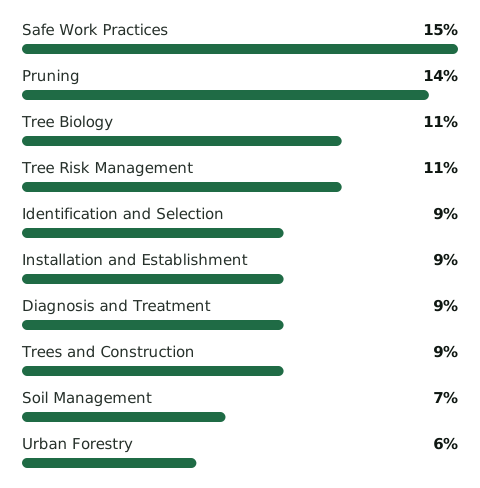
The short version
The Arborists' Certification Study Guide, Fourth Edition is ISA's own study book for the Certified Arborist exam and the natural base for reading and concept review. It gives you the vocabulary, diagrams, domain coverage, and chapter structure you need before you start judging readiness with practice questions.
Do not use it like a novel. Use the Fourth Edition as a workbook: map chapters to the current ISA exam outline, turn key terms into recall prompts, answer the chapter questions, then drill weak domains with practice questions. Reading the book once is not the same as being ready for a timed 200-question exam.
In this article
- What the Fourth Edition is
- Why candidates search for this book
- Start with the ISA exam outline, not chapter one
- How to read the book actively
- Are the Study Guide sample questions enough?
- How to pair the book with practice questions
- What changed from older editions?
- How to use the book in a 30-day plan
- When to stop reading and start testing
- Buying and official-source caveats
- FAQ
- Bottom line
What the Fourth Edition is
ISA's store describes the Arborists' Certification Study Guide, Fourth Edition as a fully illustrated resource for ISA Certified Arborist candidates and tree care professionals. The official product page lists Sharon J. Lilly, Corinne G. Bassett, James Komen, and Lindsey Purcell as authors, and describes the book as a 2022 softcover edition with 468 pages.
According to ISA's product description, the Fourth Edition includes:
- color illustrations and photos
- nearly 200 new photos and illustrations compared with the prior edition
- enhanced chapters on pruning, risk assessment, climbing, and urban forestry
- consistency with BMP revisions as of February 2021
- a comprehensive arboricultural glossary
- learning objectives, key terms, workbook sections, challenge questions, sample test questions, and recommended resources in chapters
That makes it useful for exam prep, but it is still a study guide. It is not a live exam policy page, not a guarantee, and not a substitute for checking the current ISA Certified Arborist credential page and exam outline.
Why candidates search for this book
Most candidates are trying to answer one of four questions:
- Is the Fourth Edition the right book for the current ISA Certified Arborist exam?
- Should I read the whole book or only weak chapters?
- Are the chapter questions enough practice?
- How do I combine the book with mock exams and question banks?
The practical answer: use the Fourth Edition as the concept base, then use the official exam outline and practice data to decide where to spend time. The exam is not won by owning the book. It is won by applying the material under multiple-choice pressure.
Start with the ISA exam outline, not chapter one
Before opening the book, open the current ISA Certified Arborist exam outline from ISA's official site. The outline is your map. The study guide is the material you use to fill that map.
Set up a simple table:
| Exam domain | Study guide chapters or sections | Practice score | Next action |
|---|---|---|---|
| Tree Biology | CODIT, cambium, wound response, roots | 72% | review wound response and retest |
| Pruning | objectives, cuts, young-tree pruning, risk reduction | 81% | maintain with mixed questions |
| Soil Management | compaction, drainage, pH, root-zone oxygen | 64% | reread and drill focused sets |
| Tree Risk | defects, targets, likelihood, consequences | 69% | practice scenarios before another mock |
This prevents the common mistake of giving every chapter equal weight in your schedule. Some sections support multiple domains. Some topics are already strong because of your work experience. Some deserve more repetition because they create repeated misses in practice.
Use the ISA Certified Arborist exam domains guide if you want a practical breakdown of how each domain tends to show up in questions.
How to read the book actively
A passive read-through feels productive but often leaves candidates unprepared for scenario questions. Use a four-pass method instead.
Pass 1: Skim for structure
Spend the first sitting understanding how the book is organized. Look at the learning objectives, key terms, diagrams, glossary, workbook sections, and sample questions. Do not highlight half the page. Your goal is to know where concepts live.
Write down the domains that already feel familiar and the ones that look weak. For many working candidates, the weak areas are not always the most technical ones. Soil, installation, construction impacts, and urban forestry often get less daily attention than pruning or safe work practices.
Pass 2: Read by domain
Read with a domain goal. If you are studying soil management, do not jump randomly between chapters. Focus on concepts that change field decisions:
- compaction and pore space
- drainage and oxygen movement
- pH and nutrient availability
- root-zone protection
- planting depth and root flare problems
- construction damage and grade changes
Pass 3: Convert terms into prompts
Do not only copy definitions. Turn important terms into prompts that force application.
Weak prompt:
Define CODIT.
Better prompts:
What does CODIT explain about wound response after pruning?
Why does a flush cut create a different problem than a proper branch collar cut?
Which wrong answer would sound tempting if I only memorized the definition?
Use this especially for terms that appear across domains: CODIT, cambium, branch collar, root flare, soil compaction, included bark, target, likelihood, consequence, and ANSI-style safety language. The arboriculture glossary is useful for quick recall, but the exam usually rewards applying terms to a site condition or recommendation.
Pass 4: Answer, review, and retest
Use the book's workbook sections, challenge questions, and sample test questions as checkpoints. Then switch to independent practice so you are not only recognizing questions from the same chapter context.
For each missed question, write one sentence:
I missed this because ____; next time I should notice ____.
Examples:
- I missed this because I confused symptoms with signs; next time I should separate host response from visible pest evidence.
- I missed this because I jumped to pruning before clarifying the objective; next time I should identify why the work is being done.
- I missed this because I treated compaction as only a soil texture issue; next time I should think about pore space, oxygen, and water movement.
That sentence is more useful than rereading a whole chapter because it targets the actual failure mode.
Are the Study Guide sample questions enough?
No, not by themselves.
The chapter questions and sample test questions are useful because they reinforce the material you just read. They are not enough to prove exam readiness. The real challenge is answering mixed, timed, scenario-style multiple-choice questions when the domain is not obvious.
Use the book questions for concept checks. Use broader practice questions for exam behavior:
- Can you identify the domain without chapter context?
- Can you choose the best answer when two choices sound plausible?
- Can you avoid over-treating diagnosis questions?
- Can you keep safe work practices conservative under pressure?
- Can you flag and move on when one item is taking too long?
If you need a quick starting point, use free ISA Certified Arborist practice questions.
How to pair the book with practice questions
A clean weekly cycle looks like this:
- Read one domain section in the Fourth Edition.
- Make a short list of terms and decisions from that section.
- Take 20 to 40 focused practice questions in the same domain.
- Review every miss and guessed-right answer.
- Reread only the relevant pages, not the whole chapter.
- Retest that domain after a day or two.
- Mix it with other domains once the focused score improves.
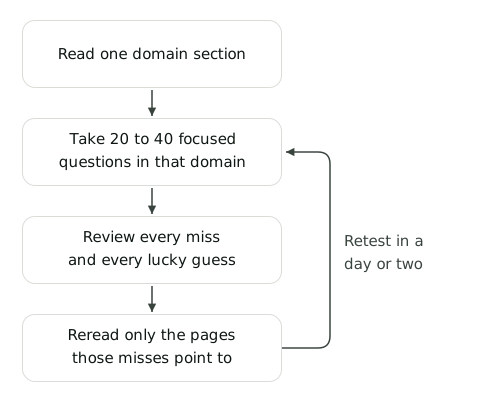
This keeps the book tied to feedback. If practice shows that tree risk is weak, reread risk assessment and then drill risk scenarios. If the weak domain is identification and selection, spend less time memorizing species lists and more time on site fit, mature size, tolerances, nursery stock quality, and stress factors.
What changed from older editions?
The Fourth Edition replaced the third edition from 2010. ISA's product page describes the Fourth Edition as a new edition with updated illustrations, enhanced pruning, risk assessment, climbing, and urban forestry chapters, and consistency with BMP revisions as of February 2021.
If you already own an older edition, do not assume it is worthless, but be careful. Exam prep should use current terminology, current best management practice references, and the current exam outline. An older book may still explain fundamentals, but you should not make it your only source unless your instructor or ISA materials specifically tell you it is acceptable for your exam window.
If you are buying now, buy the Fourth Edition.
How to use the book in a 30-day plan
If you have about a month, do not try to read every page twice. Use the book to build a first pass, then let practice data control the second pass.
A practical 30-day structure:
| Timing | Main use of the Study Guide | Practice layer |
|---|---|---|
| Days 1-3 | map chapters to the exam outline | short mixed baseline |
| Days 4-11 | read core biology, pruning, diagnosis, soil, installation, and selection sections | focused domain sets |
| Days 12-15 | read construction, risk, safety, and urban forestry sections | focused domain sets |
| Day 16 | review notes and weak terms | 50-75 question mixed set |
| Days 17-21 | reread only the two weakest domains | retest weak areas |
| Days 22-23 | quick reference review, not new reading | first full timed mock |
| Days 24-29 | targeted reread from mock results | repair misses and take a final check |
| Day 30 | light review and logistics | no new resource collecting |
For the full schedule, use the ISA Certified Arborist 30-day study plan.
When to stop reading and start testing
Switch from reading to practice when you can explain the chapter vocabulary but still do not know whether you can apply it. That is the point where another passive read-through gives diminishing returns.
Signs you need practice more than reading:
- you understand the definitions but miss scenario questions
- you keep choosing the second-best action
- you miss qualifiers such as first, best, most likely, least, or except
- you recognize a topic but cannot decide which field clue matters most
- your practice misses cluster in the same domain even after reading it
Signs you need to return to the book:
- you cannot define key terms in your own words
- you miss because you do not know the mechanism
- you guess on diagrams, defects, root-zone issues, or pruning terminology
- explanations mention concepts you cannot find in memory
- you are memorizing answers instead of understanding why they are correct
The best prep moves back and forth. Read, test, review, reread the exact weak section, then test again.
Buying and official-source caveats
Use ISA's official store or authorized channels when checking the current edition, price, availability, formats, and shipping. ISA's product page may show member and non-member pricing, inventory status, and edition details, but those can change.
Do not rely on a random marketplace listing for exam policy or edition guidance. A bookstore can sell the book; it cannot tell you whether your eligibility, authorization window, scheduling rules, or exam outline have changed. For those, use ISA and Pearson VUE directly.
FAQ
Is the Arborists' Certification Study Guide official ISA material?
Yes, the Arborists' Certification Study Guide is an ISA publication sold through ISA's store. Arborist Practice is independent and not affiliated with ISA; this article is only guidance on how to use the book for studying.
Is the Fourth Edition enough to pass the ISA Certified Arborist exam?
It is a strong foundation, but ISA's store says no study material, ISA's own included, should be your only source. Add the current exam outline, practice questions, timed mock exams, and careful missed-answer review. A book can teach the content. It cannot prove pacing, stamina, or multiple-choice judgment by itself.
Should I read the whole Study Guide before taking practice questions?
Usually no. Read enough to understand the domain, then take focused questions to expose weak spots. Waiting until you finish the entire book before testing can hide problems until too late.
Are the sample questions in the book real ISA exam questions?
No. ISA says the study guide is developed separately from its certification exams, so its questions are practice, not exam items. Use chapter questions and sample questions for learning, not for memorizing supposed exam content.
Should I buy the Fourth Edition if I have the third edition?
For current exam prep, the Fourth Edition is usually the safer choice because it replaced the 2010 third edition and ISA describes it as updated with enhanced chapters and newer BMP consistency. If you already own the older edition, check current ISA guidance and consider using the Fourth Edition or current official materials to avoid stale terminology.
Bottom line
Use the Arborists' Certification Study Guide, Fourth Edition as your official reading base, not as your entire prep system. Map it to the ISA exam outline, read actively, turn terms into prompts, answer chapter questions, then use practice questions and timed mocks to measure whether the material transfers to exam decisions.
When the book shows you what to know and practice shows you what you still miss, your study time gets much cleaner.
Reading is half of it. See where you stand.
A free 20-question practice test across all ten domains, weighted like the real exam, with every answer explained. No account needed.

About Arborist Practice
Arborist Practice is independent and not affiliated with the International Society of Arboriculture. This guide is not official ISA material, does not include real ISA exam questions, and does not guarantee a passing score. Always confirm current exam requirements, official publications, prices, availability, and policies on ISA's website.